
PMSM applications: hydraulic pumps and compressors
Hydraulic pumps and compressors are the two applications where a permanent magnet synchronous motor (PMSM) saves the most. We show step by step where an induction motor wastes energy and how a PMSM with a drive recovers it.
Energy efficiency in hydraulic pumps with PMSM
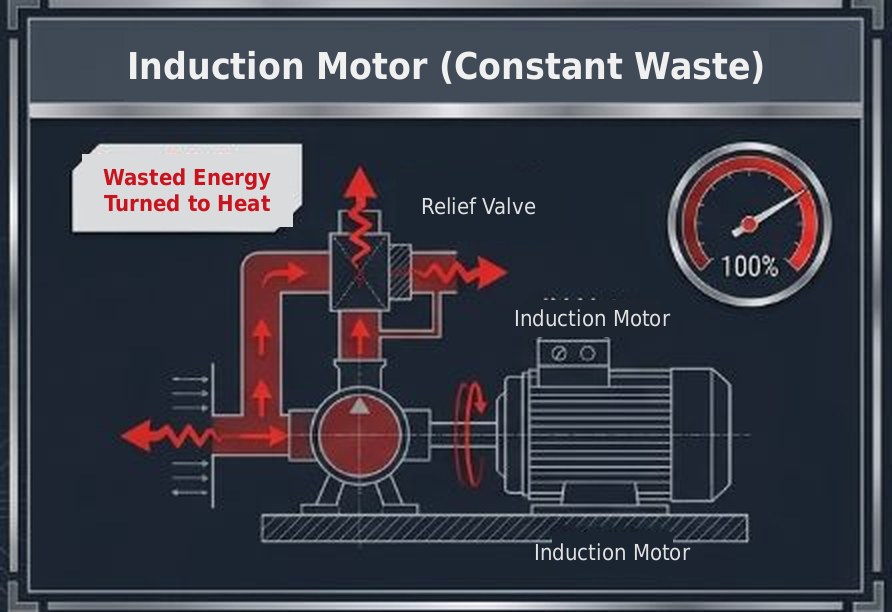
ProblemThe induction motor always runs at full speed
- As long as the speed is constant, a fixed-displacement pump delivers the same volume of oil on every revolution.
- Variable-displacement pumps adjust the flow with a swash plate, but in both cases the motor keeps turning at full speed.
- Excess oil flows through the relief valve, and this energy is turned into heat and lost.
- Hydraulic pumps need high breakaway torque when starting under load. A drive-fed induction motor may not deliver this torque at low speed and can stall, so simply adding a drive to the existing motor is often not enough.
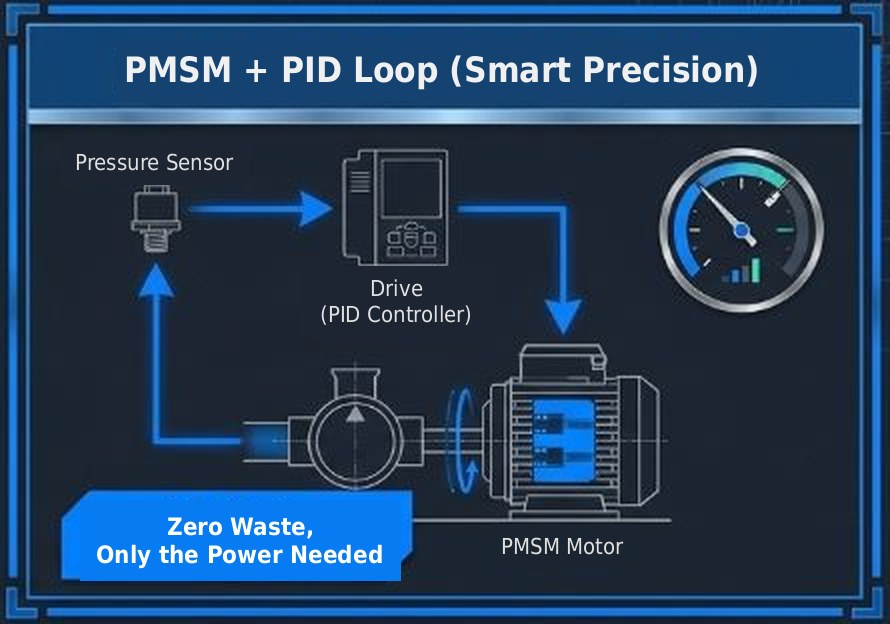
SolutionPMSM + drive + pressure sensor (PID)
- A pressure sensor measures the line pressure and sends it to the drive.
- PID loop: the drive compares the measured pressure with the setpoint and raises or lowers the motor speed instantly.
- During holding phases that need pressure but no flow, such as press mould clamping, the speed drops to a minimum; wasted oil and losses disappear.
- A PMSM delivers high torque at low speed, so pressure is held even at low speed and there is no stalling at start-up.
Energy efficiency in compressors with PMSM
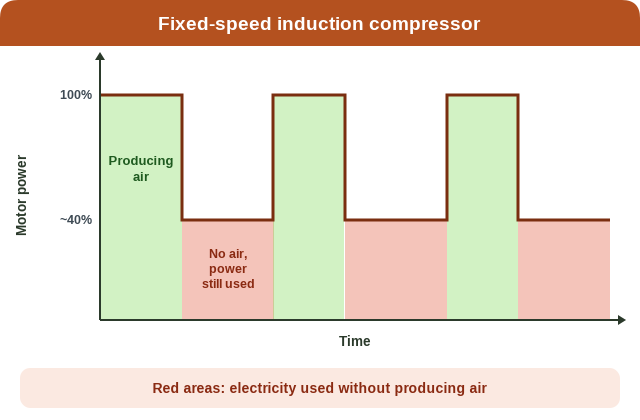
ProblemUnloaded running losses
- When air demand drops, a fixed-speed compressor does not stop; it closes the inlet valve and keeps running unloaded.
- No air is produced, but the motor turns at full speed and keeps drawing 30–50% of full-load power without doing any work.
- Screw compressors need high breakaway torque at start-up and during sudden load changes; an induction motor struggles to provide this torque at low speed.
- Adding a drive makes it possible to reduce speed, but as long as the motor stays an induction motor, low-speed performance and stalling issues can remain.
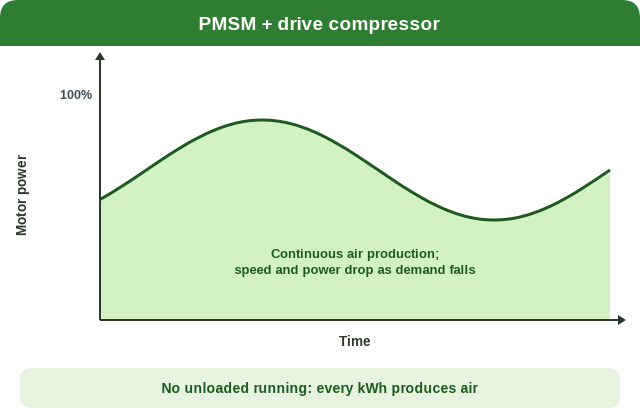
SolutionPMSM + drive + pressure control
- The pressure sensor, drive and PID loop work together; the compressor produces exactly the air the plant needs.
- A PMSM uses magnet torque and reluctance torque together, preventing stalling and torque shortage at low speed.
- Going below about 30–40% of rated speed is risky for an induction motor under heavy load, while a PMSM runs efficiently at low speed too.
- The unnecessary pressure band and unloaded running are eliminated, and pressure becomes more stable.
From measurement to proposal
Second-by-second recording of a 30 kW motor driving the hydraulic shear of an aluminium billet furnace.
Most of the time is spent idling
- Idle: 46.7 min per hour, at 10% of rated power
- Cutting: 13.3 min per hour
While idling, the induction motor still turns at full speed (985 rpm) and draws 4.10 kW.
Power drawn while idling
While idling, speed drops from 985 to 400 rpm. When a cut is needed, the drive ramps back to full speed; production rate is unchanged. 62% less power while idling.
Where does the saving come from?
- Motor replacement (lower losses): 4,380 kWh/yr
- Speed reduction while idling: 14,391 kWh/yr
Most of the saving comes from eliminating the energy wasted while the machine is idle.
Before / after
Basis: 3,599-second recording at one sample per second, 8,760 operating hours per year. *Costs in USD at an industrial electricity price of $0.20/kWh, based on the EU average for non-household consumers (€0.18/kWh, Eurostat, H1 2026) at €1 = $1.12. Drive losses are included in the PMSM figures. Savings were verified on site by repeating the same measurement after conversion.
Free initial assessment for your motors
Tell us about your largest or longest-running motors and we will estimate the savings potential.