

We measure your motors' energy use and recommend the most efficient system.
Electric motors consume most of the electricity in industry. We measure your motors on site, replace them with IE4 permanent magnet synchronous motors (PMSM) and drives where it pays off, and verify the savings after conversion.
Your reliable partner in motor efficiency
Measured savings for industrial plants in Türkiye
We are an engineering company in Darıca, Kocaeli, focused on the energy efficiency of electric motors, working with large factories and SMEs alike.
We measure every motor on site, while the machine is in normal production, and recommend a change only when we find a meaningful savings potential.

From measurement to commissioning
Motor energy survey
Power analyser recordings at the motor's panel, split into idle, part-load and full-load states, with a motor-by-motor savings and payback report.
More →PMSM motor conversion
Replacing induction motors with IE4 permanent magnet synchronous motors and drives, sized to the measured torque. Turnkey installation and verification.
More →Verification and reporting
After conversion we repeat the same measurement and report the savings in kWh, cost and CO₂, ready for ISO 50001 reviews and customer reporting.
See a case →Where is the loss, where is the gain?
An induction motor keeps producing fixed losses even when the load drops; it turns at full speed even when the machine is doing no work. In a PMSM the rotor carries magnets, so a large share of these losses disappears.
- No rotor copper loss. The rotor has embedded magnets instead of windings.
- High efficiency at part load. The difference is largest on machines running at light load.
- Speed reduction while idling. Speed drops when there is no work and returns when needed; production rate is unchanged. (Speed can also be reduced by adding a drive to an existing induction motor or on an induction motor that already has one; however, when ramping from low to high speed under load, an induction motor can stall from insufficient torque. A PMSM delivers high torque at low speed, so this risk is eliminated.)
- Compact design. Higher power density allows a smaller frame for the same output.
| Induction (IM) | PMSM + drive | |
|---|---|---|
| Efficiency class | Typically IE1–IE3 | IE4 |
| Rotor loss | Yes | None |
| Part-load efficiency | Drops noticeably | Stays high |
| Frame | Large frame | Small, compact frame |
| Torque at low speed | Limited | High |
| Power factor | Load-dependent, low | High |
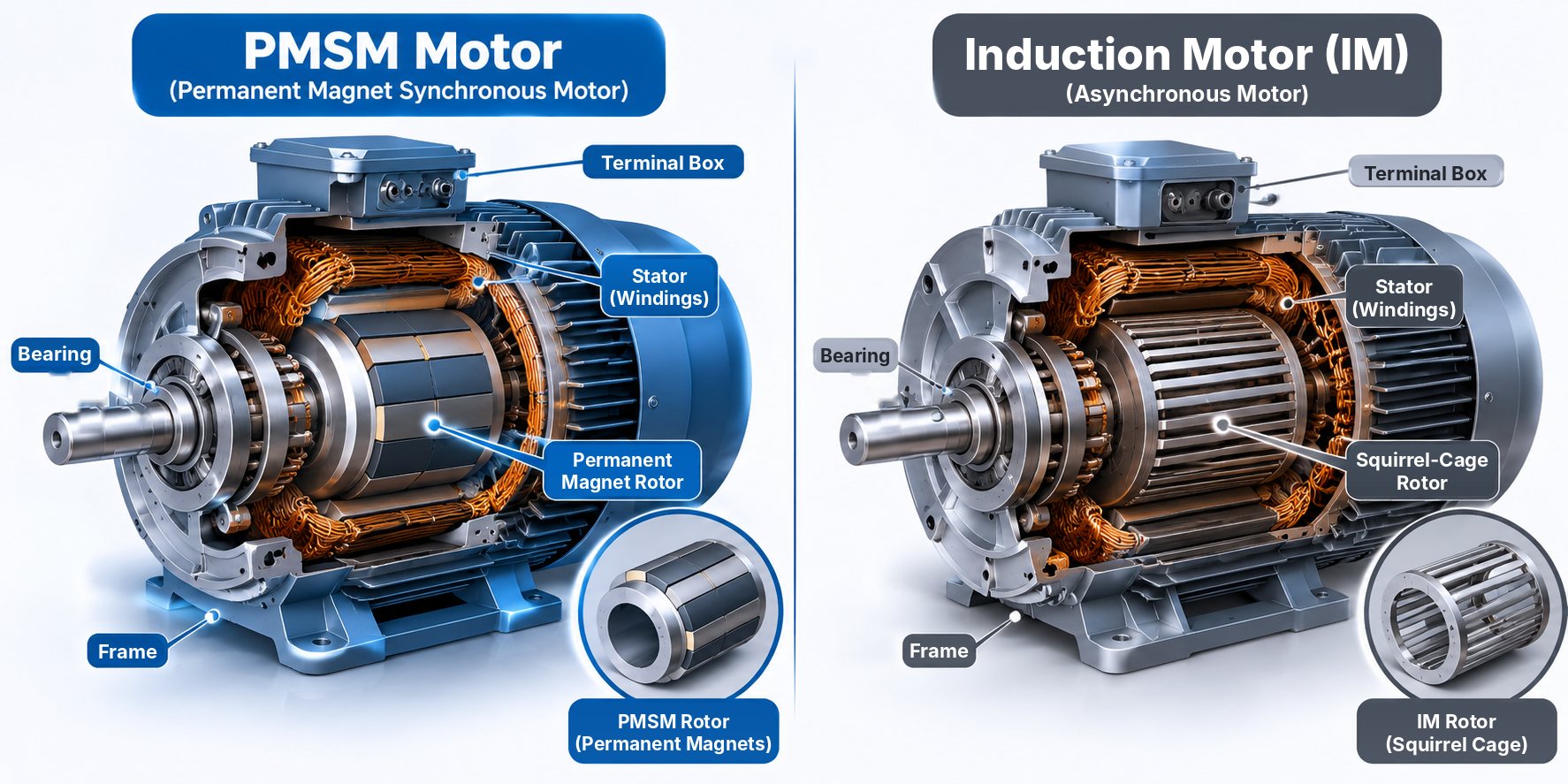
PMSM and induction motor side by side
Both motors have a similar stator; the difference is the rotor. A PMSM rotor carries permanent magnets, an induction motor rotor has squirrel-cage bars. With no rotor current, a PMSM has no rotor losses.
Power factor (cosφ)
Energy consumption
Values are averages of our measurements before and after conversion. Results vary from plant to plant; the most reliable way is to start by measuring your existing motor. In our measured billet shear project: 25.8% less energy, cosφ 0.49 → 0.95 →
From the field
Every project starts with a power analyser measurement at the panel the motor is connected to.


Measurable savings in four steps
Initial assessment
Motor inventory, operating hours and duty profile are reviewed.
Motor survey
Motors are recorded with a power analyser during normal production.
Report and quotation
Feasibility report with savings, investment and payback period.
Implementation and verification
The measurement is repeated after conversion and the savings are documented.
Documented savings for your EU customers
After each conversion we repeat the same measurement and report the savings in kWh, cost and CO₂. These measured figures support ISO 50001 energy reviews, sustainability reporting and the emissions data requests that EU customers increasingly send to their Turkish suppliers.
Free initial assessment for your motors
Tell us about your largest or longest-running motors and we will estimate the savings potential.